Current and Recent Missions
TRACERS
Dr. Miles is PI for TRACERS (Tandem Reconnection and Cusp Electrodynamics Reconnaissance Satellites) mission, consisting of two identical satellites in tandem orbit, which launched July 23, 2025, from Vandenberg Space Force Base. This mission will help answer long-standing questions key to understanding space weather, particularly how the Sun transfers energy, mass, and momentum to near-Earth space.

ICI-5b
ICI-5b will study plasma turbulence and irregularities in the auroral ionosphere as a contribution to the international Grand Challenge Initiative – MLT (Mesosphere-Lower Thermosphere). The Norwegian-built research rocket was launched from Andøya Space, Oksebåsen, on March 11, 2026.

OCHRE
The OCHRE student-led sounding rocket mission will study cusp dynamics in the Earth’s magnetosphere and help train the next generation of space physicists and instrumentalists. OCHRE will be launched in the Winter 2025-26 from Andøya Space Center, Norway to coincide with a flyover from the TRACERS spacecraft mission.

ACES-II
This mission, led by Scott Bounds, launched two rockets into an aurora to measure the interaction between solar magnetic particles and the Earth’s magnetic field. The rockets were launched in Andøya, Norway in 2022.
Instrumentation Projects


CHIMERA Hybrid Magnetometer
The CHIMERA hybrid magnetometer for Smallsats combines search coil and fluxgate magnetometers into one package. CHIMERA is a hybrid magnetometer that operates simultaneously as a search coil magnetometer and as a fluxgate magnetometer, offering improved operational flexibility compared to conventional two-instrument approaches. Utilizing digital signal processing and demodulation, this instrument shifts key magnetometer functions from analog electronics to field-programmable gate array-based digital processing and was test-flown on the ACES-II suborbital rocket mission.

CABOOM
This project demonstration involved a CubeSat boom arm with a magnetometer for surveying the Earth’s magnetic field. The zero-gravity test flight, which included a test model mounted with optical sensors, characterized the deployment system and its repeatability.
The goal of this flight test was to validate and analyze two enhanced versions of the CubeSat magnetometer boom. During a parabolic flight experiment, both booms were repeatedly deployed, and their deployment dynamics and final orientation were tracked using motion capture technology.
e-POP
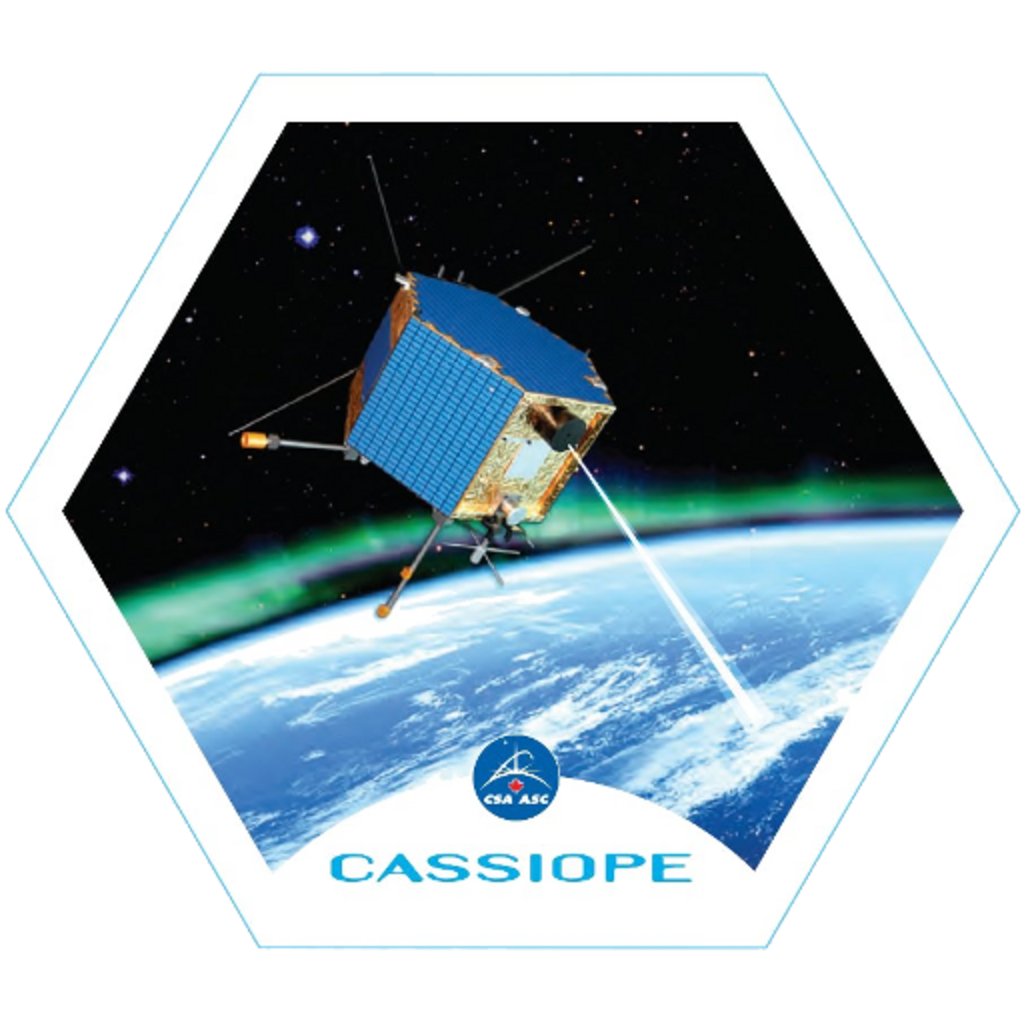
The Enhanced Polar Outflow Probe (e‑POP) is a research payload on the CASSIOPE spacecraft that is collecting new data on space storms and associated plasma outflows from the Earth’s ionosphere.
Testing Centers
The Department of Physics and Astronomy offers trained support and operational staff able to develop fixturing, integration, and test plans to meet your project needs.
Services include wide temperature range vacuum testing, vibration testing, mass testing, thermal testing, and EMI/EMC Testing.
Magnetic Furnace
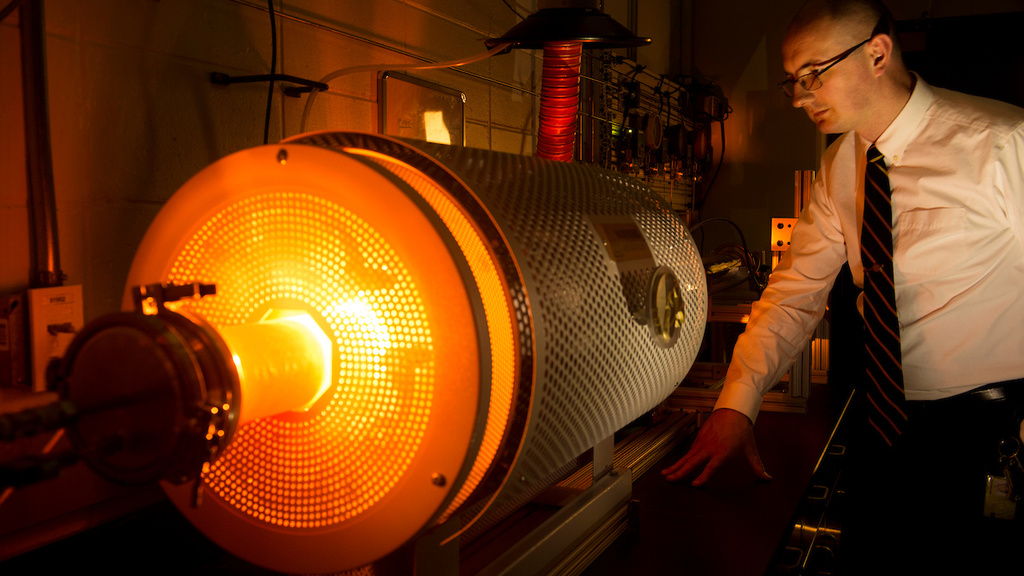
This furnace is used to manufacture a critical space-instrument component called a ring core, which is central to the functioning of a fluxgate magnetometer, an instrument used for measuring low-frequency magnetic fields.
Read more in this Iowa Now article.
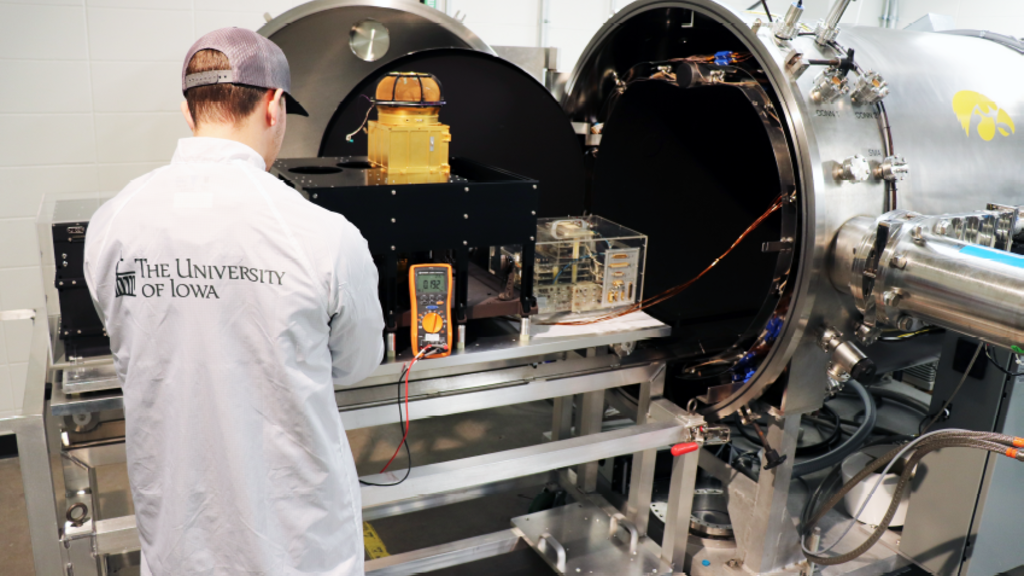
Thermal Vacuum Test Chamber
The chamber is used to testing of spacecraft components under simulated environmental space conditions such as cold or high temperatures.
News

UI researchers aid rocket launch in Norway
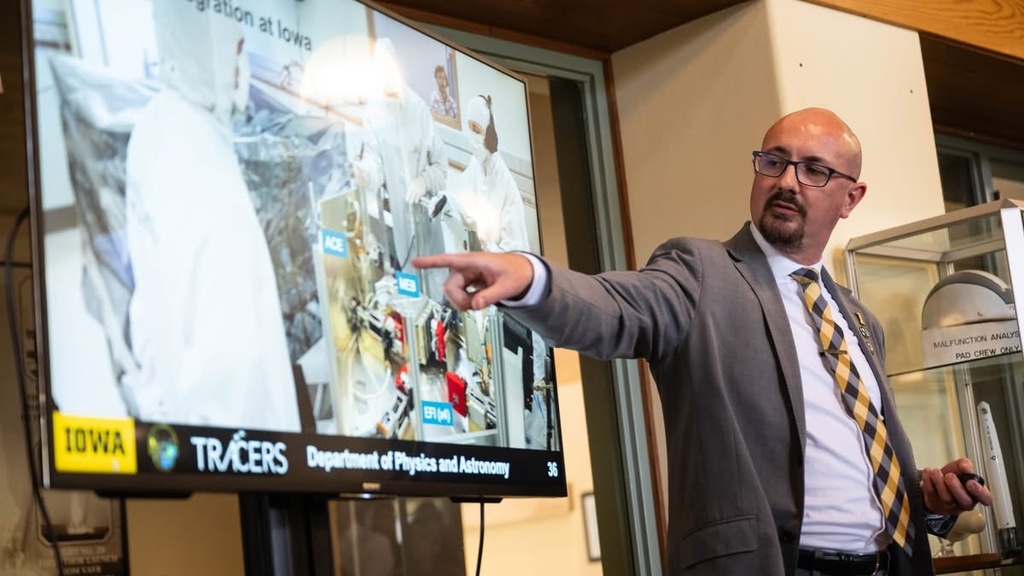
UI OVPR Names Miles Scholar of the Year
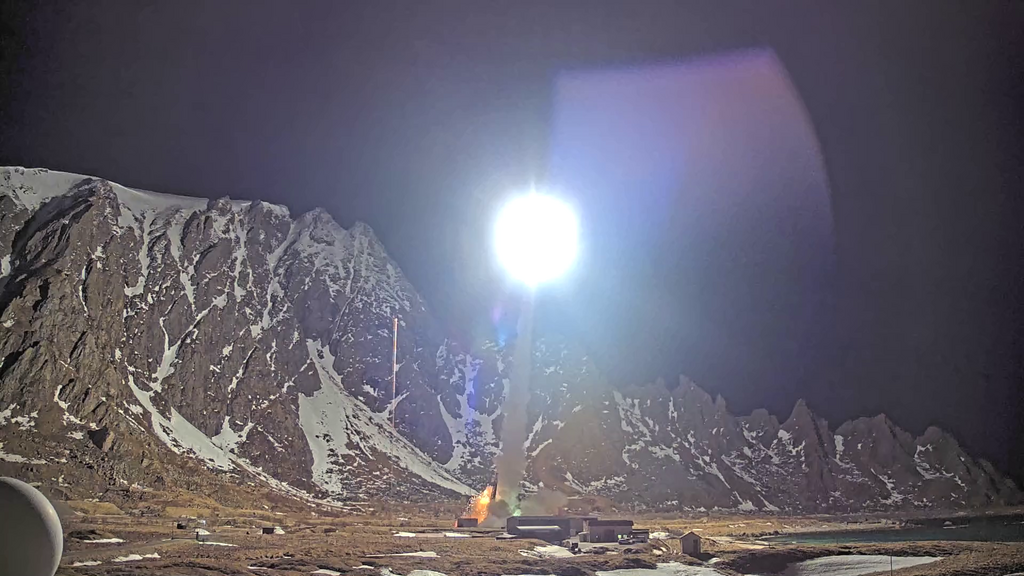
Successful launch of ICI-5b